The Portugal digital nomad visa is the D8, and in 2026 it asks for average monthly income of at least 3,680 EUR, four times the mainland minimum wage, plus a savings buffer of about 11,040 EUR. It is open to non-EU remote workers and freelancers whose income comes from outside Portugal, and it leads to a two-year residence permit and a path to permanent residence after five years.
The rules moved in 2026, and a lot of the advice online is out of date. The income bar rose with the minimum wage, the old tax break closed to new applicants, and consulates have become stricter about accommodation and proof of income. This guide to remote work in Portugal sets out the current D8 requirements, the application step by step, what you actually pay in tax, the real cost of living, and where to base yourself. It completes the site’s remote work series with Spain, Greece, Malta and Italy, and the Portugal itinerary covers the short trip version of the same country.
Plan and book
3 partners- Flights
Fly into Lisbon or Porto, with direct links across Europe and to the islands. Compare routes.
Search flights - Trains
Move between Lisbon and Porto in under three hours on the Alfa Pendular, useful for scouting bases.
Compare trains - Where to live
Apartments and long-stay lets in Lisbon, Porto, Madeira and the Algarve.
Find a place
Why Portugal
The practical case comes first. Portugal is an EU and Schengen country, so once you have residence you can move freely through Europe, and the euro and the CET time zone make banking and client calls simple. English is spoken far more widely than in neighbouring Spain, which removes the daily friction of living somewhere new, and the country has one of Europe’s highest amounts of sunshine, with a mild winter on the south coast and the islands.
Then there is the cost. Portugal is the cheapest country in Western Europe’s warm belt, well below France, Italy or the Netherlands, and the gap matters most in rent and food. There is a real remote-work and expat community in Lisbon and Porto, with coworking spaces, meetups and fast internet, and the lifestyle, surf, seafood, old cities and easy travel, is the part people come for. The trade is that city rents have risen sharply with the popularity, and the visa bar is higher than it used to be, so Portugal is no longer a bargain in Lisbon and Porto even if it remains one elsewhere.
The other draw is the residency route. Unlike a short-stay nomad visa, the D8 leads to a residence permit, and the permit can be renewed. For anyone planning a multi-year base in Europe rather than a season, that stability is the difference between Portugal and a series of three-month stays.
Who qualifies
The D8 is for nationals of countries outside the European Union, the European Economic Area and Switzerland. You must be earning active income from work performed outside Portugal, either as an employee of a foreign company or as a freelancer with foreign clients. Passive income such as pensions, rent or dividends belongs to the D7 route, not the D8.
EU, EEA and Swiss citizens do not need the visa and cannot use it, because they already hold the right to live and work in Portugal under free movement rules. For a stay longer than three months they register for a Certificate of Registration with the local authority. The D8 is reserved for third-country nationals, which includes UK citizens since Brexit.
One common misunderstanding is worth clearing up early. If you are looking for digital nomad jobs in Portugal, meaning a job with a Portuguese employer, the D8 is the wrong route. The permit is built on the premise that your income stays outside the Portuguese labour market. A Portuguese job offer needs an employer-sponsored work visa, and the two routes have different documents and different tests.
The visa comes in two forms. A temporary stay visa covers stays of less than a year. The residency visa is the one most remote workers want: it is valid for four months with two entries, and during that window you travel to Portugal and apply for a residence permit at AIMA, the immigration agency. The official visa portal sets out the distinction.
D8 requirements
The financial test is the part that decides most applications. The main applicant must show average monthly income of at least four times the Portuguese minimum wage. The mainland minimum wage rose to 920 EUR a month on 1 January 2026 under Decree-Law 139/2025, which puts the D8 bar at 3,680 EUR a month, or about 44,160 EUR a year. The figure is a statutory multiple, not a fixed number, so it rises each January when the minimum wage does.
Consulates usually look at the last three months of income, so a single strong month is not enough. Bank statements, employment contracts, client invoices and tax returns should tell the same story, and the income must be traceable to work you actually do outside Portugal. Freelancers should be ready to show contracts and a client list as well as the money arriving.
On top of the income, expect a savings requirement. Consulates generally ask for about 12 times the minimum wage, which is 11,040 EUR in 2026, with a spouse adding 50 percent and each child adding 30 percent. The exact evidence varies by consulate, and some are stricter than others, so use the checklist published by the post where you will apply rather than a general guide.
The rest of the file is practical rather than financial. You need a passport valid beyond the intended stay, proof of remote work, health insurance valid in Portugal with repatriation cover, proof of accommodation, a clean criminal record certificate with apostille and translation, and a Portuguese tax number, the NIF. Some consulates also ask for a travel itinerary and evidence that you can support dependants. The official residency documentation list is the checklist to work from, and it includes a section for remote work.
How to apply
The order matters, because each step unlocks the next. Start with the NIF, then the bank account, then the accommodation, then the visa file. Leaving the NIF or the lease until the week of the appointment is one of the most common ways a D8 application runs out of time.
1. Get a Portuguese tax number. The NIF is needed to open a bank account, sign a lease and register with the tax authority. You can apply through a fiscal representative or, in some cases, at a Portuguese consulate or the tax office after you arrive, but the consulate route is smoother if you have it before the visa appointment.
2. Open a Portuguese bank account. Some consulates accept foreign statements, but a Portuguese account makes proof of funds and future rent payments much easier. It also gives you a local IBAN for utilities and the AIMA process.
3. Secure accommodation. A 12-month lease is the safest evidence, and it is covered in the next section. Do not sign a lease you have not read, and check that the landlord can provide a contract that the consulate will accept.
4. Assemble the file. Passport, photographs, visa form, proof of income, savings, remote work, insurance, accommodation, criminal record and the NIF. Documents issued abroad usually need an apostille and a Portuguese translation, and the consulate may keep originals, so keep copies and be ready to reissue documents later.
5. Apply at the consulate or visa centre. Book the appointment in the country where you legally reside, pay the fee, and attend in person for biometrics. Processing times vary widely by post and season, so allow several months and avoid non-refundable travel bookings until the visa is in your passport.
6. Travel and apply for the permit. The residency visa is valid for four months with two entries. Once in Portugal, book the AIMA appointment, submit the residence application and give biometrics. The first permit is valid for two years, then renews in successive three-year periods. Permanent residence can be available after five years of temporary residence, subject to the other conditions.
Proof of accommodation
Accommodation is where a lot of otherwise strong applications fail. Consulates want evidence of long-term residence, not a holiday. The standard accepted documents are a signed 12-month lease, a property deed if you have bought a home, or a notarised declaration from a host together with proof of the host’s own address. A short Airbnb or hotel booking is usually not accepted, and a weak address is one of the most common reasons a D8 file is refused.
If you are searching from abroad, the practical sequence is NIF first, then bank account, then lease. Portuguese landlords and agents will ask for the NIF and proof of income, and some will ask for a guarantor. Listings move fast in Lisbon and Porto, so start the search before the consulate appointment rather than after it. Idealista is the main portal for long-term rentals, and local Facebook groups and expat forums often carry listings that never reach the big sites.
Some consulates accept a shorter lease or a host declaration, but the safe assumption is 12 months. If you plan to move after the first year, sign in a neighbourhood you can live with rather than the one you would pick for a holiday, because the lease is also the address you will use for the NIF, the bank and the residence permit.
Tax
The tax picture changed in 2024 and the old advice is now wrong. The Non-Habitual Resident regime, the NHR that made Portugal famous for tax, closed to new applicants, and it was replaced by IFICI, sometimes called NHR 2.0. IFICI offers a 20 percent flat tax on qualifying employment and self-employment income for ten years, and it can exempt some foreign income, but the eligibility is narrow. It is aimed at research, innovation, technology, health, higher education and other listed activities, and it depends on the work you do, not just on the fact that you are new to Portugal.
Most standard remote workers do not fit the IFICI conditions, and the honest planning assumption is Portugal’s standard progressive scale once you become tax resident. The rates rise in steps to 48 percent at the top, though the lower brackets mean the effective rate on a typical remote salary is lower. Tax residency generally starts after more than 183 days in Portugal in a 12-month period, and treaty rules can also affect where specific income is taxed.
Two practical points follow. First, do not move on the assumption of a 20 percent rate unless a Portuguese adviser has confirmed in writing that your activity qualifies. Second, keep your foreign income, contracts and tax residence evidence organised from the first month, because the permit renewal and the tax return will ask for the same story. The tax authority’s article on IFICI is the primary source, and the 2026 IRS rates set out the standard brackets.
Cost of living
Portugal is still the cheapest of Western Europe’s warm countries, but the cities have caught up. Rent is the swing factor. A central one-bedroom in Lisbon now commonly lists at 1,200 to 2,000 EUR a month, with cheaper options across the river, in older buildings or in less central neighbourhoods. Porto is a little cheaper, and the same money goes much further in the Alentejo, the interior or the Silver Coast. Current Lisbon listings are a better guide than any single average, because the spread between a renovated flat and an old one is wide.
Everyday costs are moderate. Numbeo’s crowd-sourced 2026 estimate puts non-rent costs for a single person in Lisbon at about 760 EUR a month, which covers groceries, transport, utilities and a reasonable amount of eating out. Food is good value, with a lunch special or a fish dinner for well under what the same meal costs in France or Italy, and transport and utilities are cheap by Western European standards.
As a planning range, a single remote worker should budget about 2,200 to 3,200 EUR a month in Lisbon or Porto, and 1,600 to 2,300 EUR elsewhere, depending on the flat and the lifestyle. The D8 income bar of 3,680 EUR covers the big cities, though a central Lisbon one-bedroom takes a large share of it. That gap is why so many remote workers end up outside the two big cities after a year or two.
Where to base
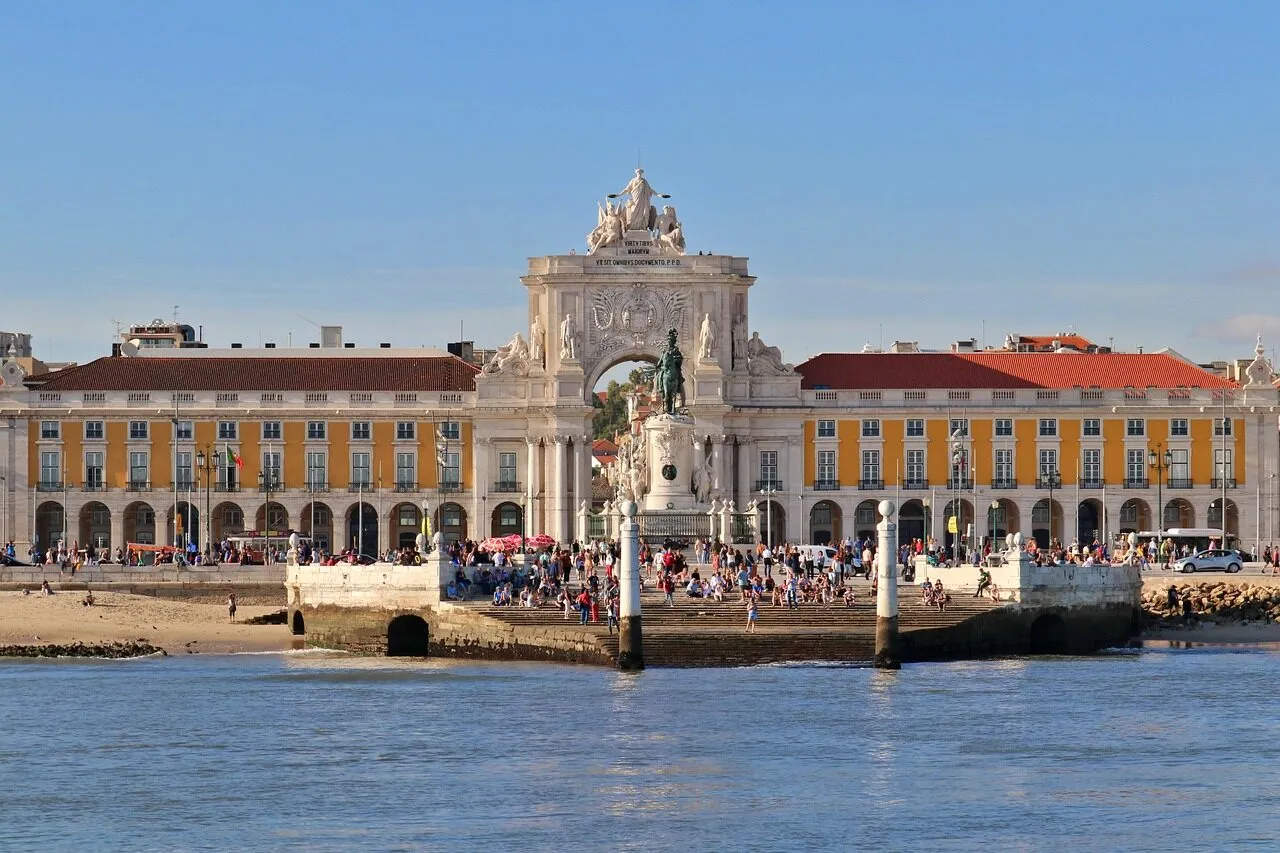
Lisbon and Porto are the two main bases. Lisbon has the deepest remote-work community, the most coworking and the best flights, at the highest rents, with neighbourhoods like Principe Real, Estrela and Alcantara balancing central living with a little space. Porto is smaller, cheaper and more manageable, with a strong cafe and coworking scene on the riverside and in the Baixa, and it suits anyone who finds Lisbon too expensive or too crowded. Both are walkable, well connected and full of places to work. The Lisbon guide and the Porto guide cover the neighbourhoods in more detail.
The islands and the coast are the alternatives. Madeira, the Atlantic island, is mild year round and has built a genuine nomad scene around Funchal and the south coast, including Ponta do Sol and Calheta, with reliable internet and a small, organised community. It is the pick for anyone who wants nature, walking and a slower pace without giving up connectivity. The Algarve, the Silver Coast around Ericeira and Peniche, and the Alentejo offer lower rents, quieter living and space, at the cost of a thinner professional scene, and they suit remote workers who no longer need to be in a city.
Internet is not usually the deciding factor. Fibre coverage is wide in mainland cities and towns, and coworking spaces are concentrated in Lisbon and Porto, with a smaller cluster in Funchal. Check the connection at the exact address before signing a lease, especially in old buildings and on the islands, and keep a mobile data backup for the first week. If your work depends on calls, test the upload speed, not just the download number in the listing.

Practical information
| Visa | The D8 remote-work visa. Residency version valid four months with two entries, then a two-year residence permit, renewable in three-year periods. Confirm current rules on the official visa portal. |
|---|---|
| Income | At least 3,680 EUR a month in 2026, four times the 920 EUR mainland minimum wage, usually averaged over the last three months. The threshold rises each January. |
| Savings | Generally about 11,040 EUR, 12 times the minimum wage, with a spouse adding 50 percent and each child 30 percent. Exact evidence varies by consulate. |
| Accommodation | A 12-month lease, property deed or notarised host declaration. Short Airbnb and hotel bookings are usually refused. Get the NIF before signing. |
| Tax | NHR closed. IFICI offers 20 percent for qualifying roles but most D8 holders do not qualify and pay standard progressive rates up to 48 percent once resident. Check with an adviser. |
| Costs | About 2,200 to 3,200 EUR a month single in Lisbon or Porto, 1,600 to 2,300 EUR elsewhere. A central Lisbon one-bedroom commonly lists at 1,200 EUR or more. |
| Language and status | Portuguese, with English widely spoken. EU and Schengen, euro, CET time zone, which suits European clients. |
| Where to base | Lisbon for community and flights, Porto for value and a smaller city, Madeira for island living and nature, the Algarve, Silver Coast and Alentejo for lower rents and quiet. |
| Path to residence | Two-year permit, then three-year renewals. Permanent residence can be available after five years of temporary residence, subject to the other conditions. |
Disclosure. This blog post contains affiliate links. If you book through them, Mediterranean Vibes may earn a small commission at no extra cost to you; it is how the site stays up.