Madeira is a green volcanic island in the Atlantic, about a thousand kilometres south-west of Lisbon and a world away from the mainland in feel. It rises almost straight out of the sea to a ridge of peaks near 1,900 metres, and the whole island is criss-crossed by a network of irrigation channels, the levadas, whose paths are now the finest walking in Portugal. Add a laurel forest that is a UNESCO World Heritage Site, black sand and natural rock pools on the north coast, and a mild climate that holds up all year, and you have one of Europe’s most rewarding island escapes.
It is also compact and easy to see, which is both its appeal and the trap: people try to do the whole island in two days and spend them in a car. This guide covers the highlights properly, from the ridge walk between Pico do Arieiro and Pico Ruivo to the levada trails and the northern pools, plus where to stay and eat, so you can pace the island the way it deserves. It fits into the wider country through the Portugal itinerary, and the Portugal country guide has the mainland.
Plan and book
3 partners- Flights
Fly into Funchal (FNC) from Lisbon, Porto or much of Europe, about 1h 40m from Lisbon.
Search flights - Tours and hikes
Pico do Arieiro sunrises, levada walks, 4x4 island tours, whale watching and the skywalk.
Browse activities - Where to sleep
Funchal hotels and old-town guesthouses, plus the south coast and the quieter north.
Find a room
Getting there
Madeira is reached by air, through Funchal’s Cristiano Ronaldo airport (FNC), which has direct flights from Lisbon, Porto and much of Europe. The flight from Lisbon is about 1h 40m, which makes the island an easy add-on to a mainland trip or a stand-alone break. For the mainland cities, see the Lisbon and Porto guides. The landing itself is a story: the runway is built partly out over the sea on pillars, and the approach over the cliffs is one of the more dramatic in Europe.
Once you land, the practical way to see the island is a rented car. The public buses connect Funchal with the main towns, but the best viewpoints, levadas and coastal stops are strung along slow mountain roads and tunnels, and a car turns a day of bus timetables into a day of your own. The roads are good but the terrain is steep and the distances take longer than the map suggests, so plan fewer stops per day than you would on the mainland. Funchal is the base for most stays, roughly central on the warmer south coast.
Funchal
Funchal is the capital and one of the most pleasant small cities in Portugal, a curve of buildings around a bay with a genuine old town behind it. The Zona Velha, the old town, is a grid of cobbled streets and painted doors, filled with restaurants and bars in the evening. Above the city, the cable car runs up to Monte and its gardens, and the Mercado dos Lavradores, the covered market, is the place to see the island’s fruit, flowers and fish under the painted tiles.
The city is also the gateway to the island’s most famous export. The Madeira wine lodges, in the old town and across the harbour, run tastings where you can work through the dry, medium and sweet styles, and the harbour itself is the departure point for the whale and dolphin watching that runs year round and peaks in spring and autumn. Give Funchal a full day, and use it as the base to come back to each evening.
The peaks
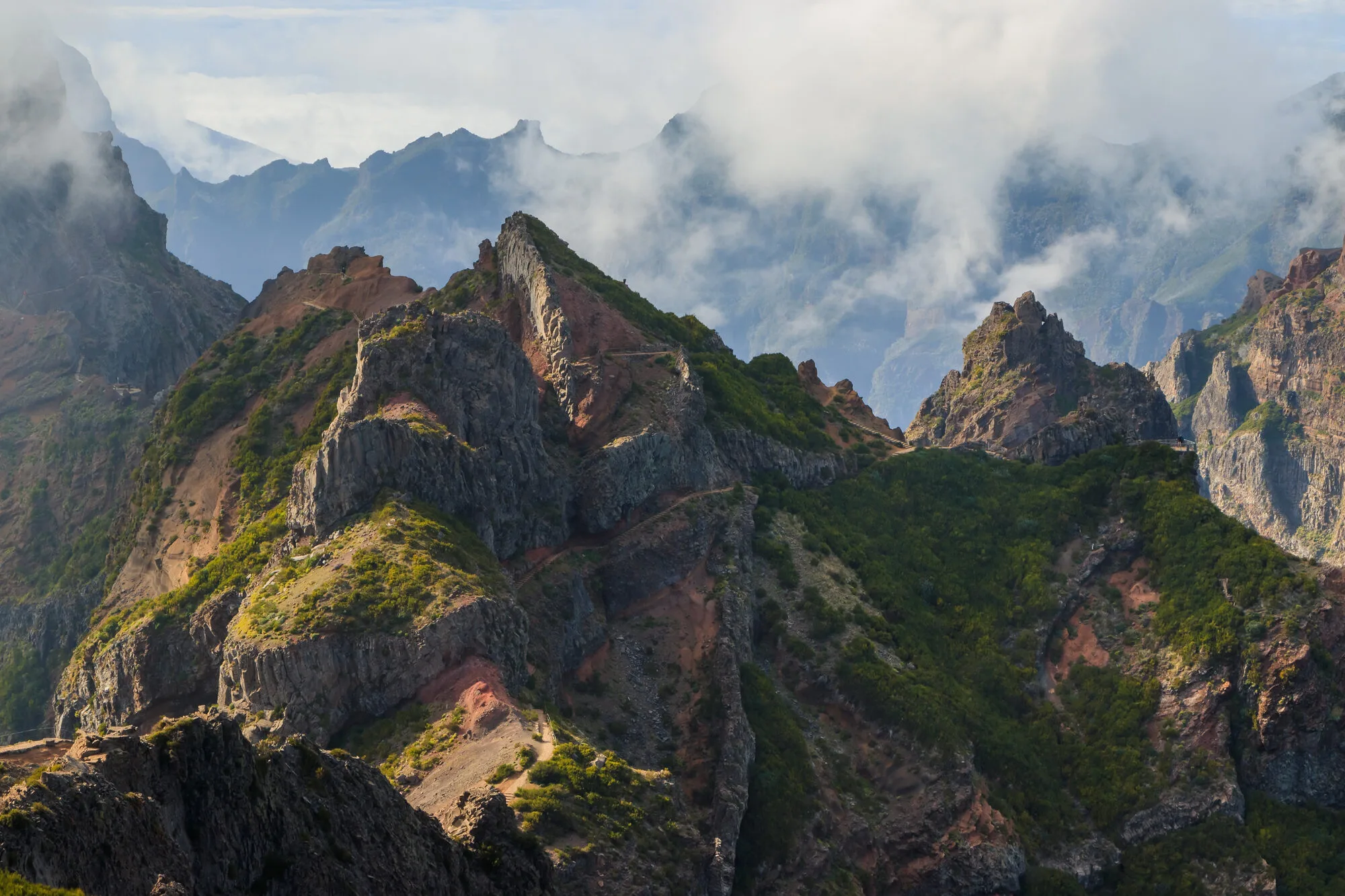
The island’s signature experience is the ridge walk between Pico do Arieiro and Pico Ruivo, the PR1 Vereda do Areeiro. Pico do Arieiro, at 1,818 metres, is the third-highest point and the start of the trail, and it is reached by a good road, which is why it is also the island’s most visited viewpoint: on a clear morning you are above a sea of cloud, with the peaks of the central massif rising through it. From there the trail runs about 9 km, 3.5 to 5 hours, to Pico Ruivo at 1,862 metres, the island’s highest summit, over exposed ridge, through rock tunnels and past the Pico das Torres.
It is a serious walk, moderate to strenuous, with real exposure and changeable weather, and it needs a timed permit booked in advance. The reward is the best mountain day in Portugal. If the full ridge is too much, the drive up to Pico do Arieiro for sunrise is worth it on its own, and the shorter viewpoints around it, including the balcony over the Curral das Freiras valley, give a taste of the same scenery without the distance.
The levada walks
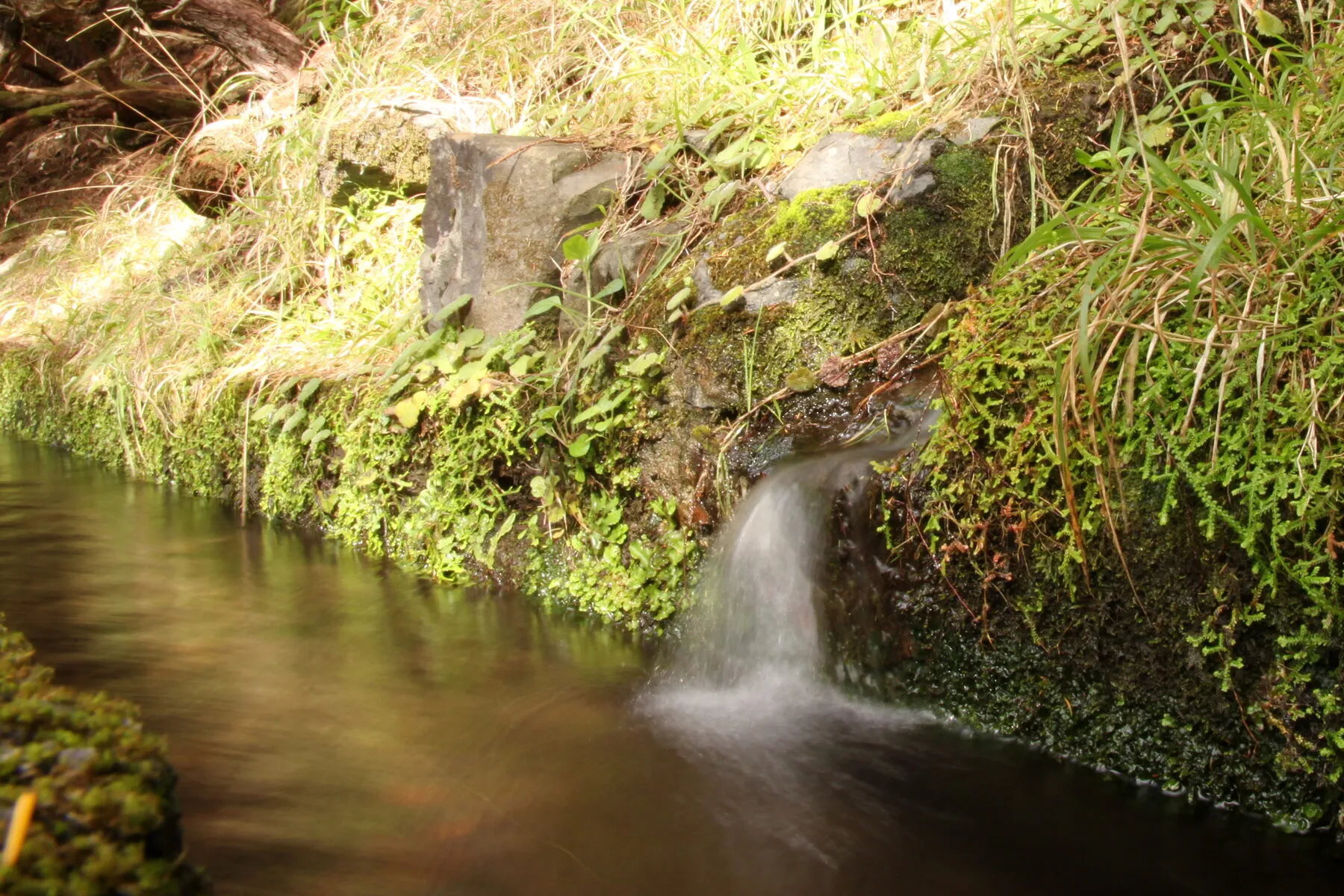
The levadas are Madeira’s other great walking tradition. They are the channels that carry water from the wet interior to the farms and towns, cut into the hillsides over centuries, and the maintenance paths beside them have become a network of trails that lead through the laurel forest, a UNESCO World Heritage Site of ancient, misty woodland. Almost every walk is green, cool and gentle to moderate, following the water along contour lines and through tunnels.
The best known is the Levada das 25 Fontes, about 11 km return and 3.5 to 4.5 hours, which ends at a pool fed by the twenty-five springs that give it its name. The Levada do Caldeirao Verde is longer and more atmospheric, about 13 km return and 4 to 5 hours, running through dense forest to a waterfall inside a volcanic gorge. For something drier and sunnier, the Ponta de Sao Lourenco trail, about 8 km return, follows the arid volcanic peninsula at the island’s eastern tip along the coast. All the classified trails need an online permit with a timed entry slot, so book before the day, and carry water and a light jacket, because the forest is cool and the weather turns quickly.
The north coast
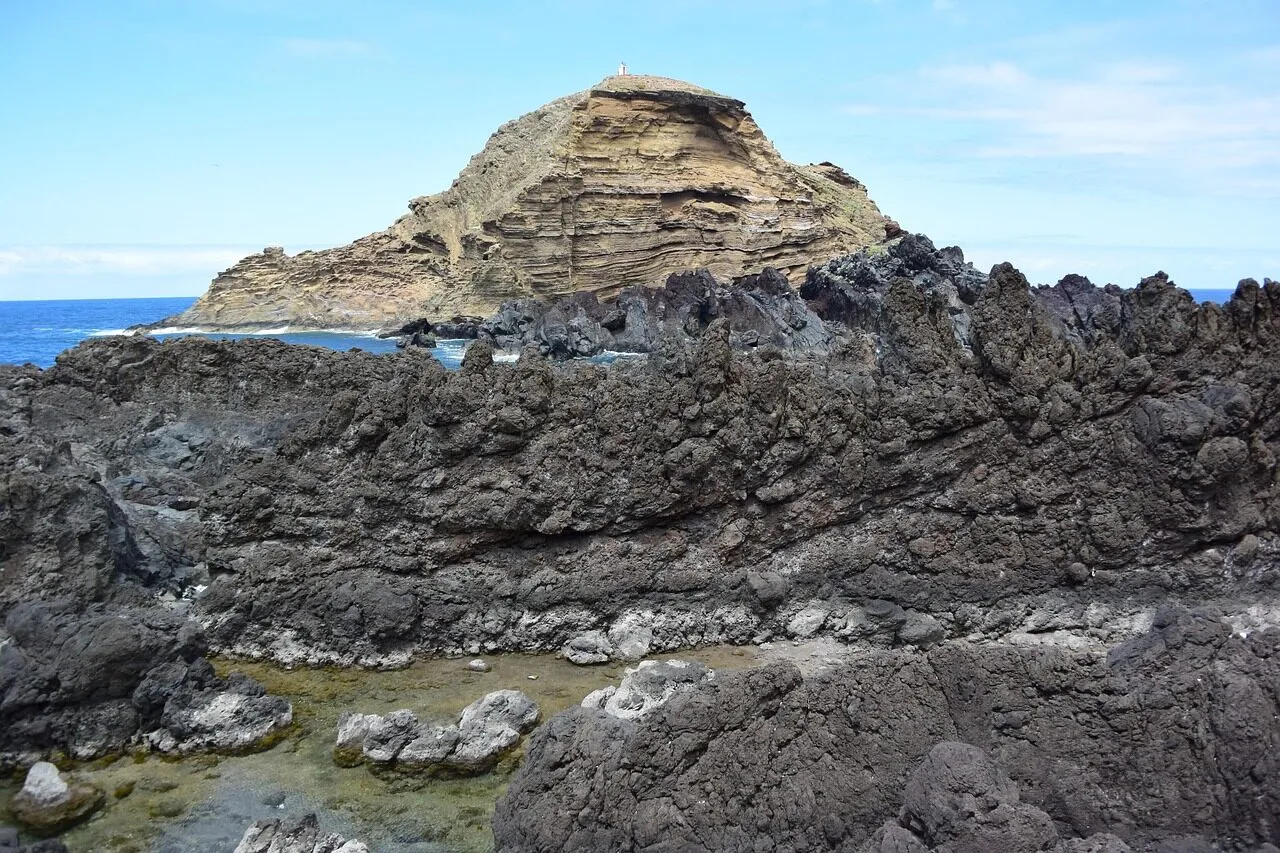
The north coast is the wilder, wetter half of Madeira, and its highlight is Porto Moniz, a village at the north-west tip where the sea has carved a set of natural swimming pools into the volcanic rock. The pools are the island’s most famous swim, cold, clear and dramatic, with the waves breaking around them, and there is a second, smaller set next to them. The drive there, along the north coast from Sao Vicente, is one of the island’s best, with waterfalls dropping straight onto the road and the cliffs falling to the sea.
Along the way, Seixal has a black sand beach and a natural pool of its own, and Sao Vicente sits in a green valley with a volcanic cave. The north is also where the rain falls hardest, which makes it the greenest and most dramatic part of the island, and the waterfall and forest stops reward anyone driving the coast over a day.
The east and west
The two ends of the island are different again. The east is dry and spiky, ending at the Ponta de Sao Lourenco, a volcanic peninsula of bare rock and coloured cliffs that juts into the Atlantic, with the coastal trail running out along it. The east is also where Santana sits, with its famous triangular thatched houses, and Porto da Cruz, with the old steam rum distillery, both easy stops on a loop back to Funchal.
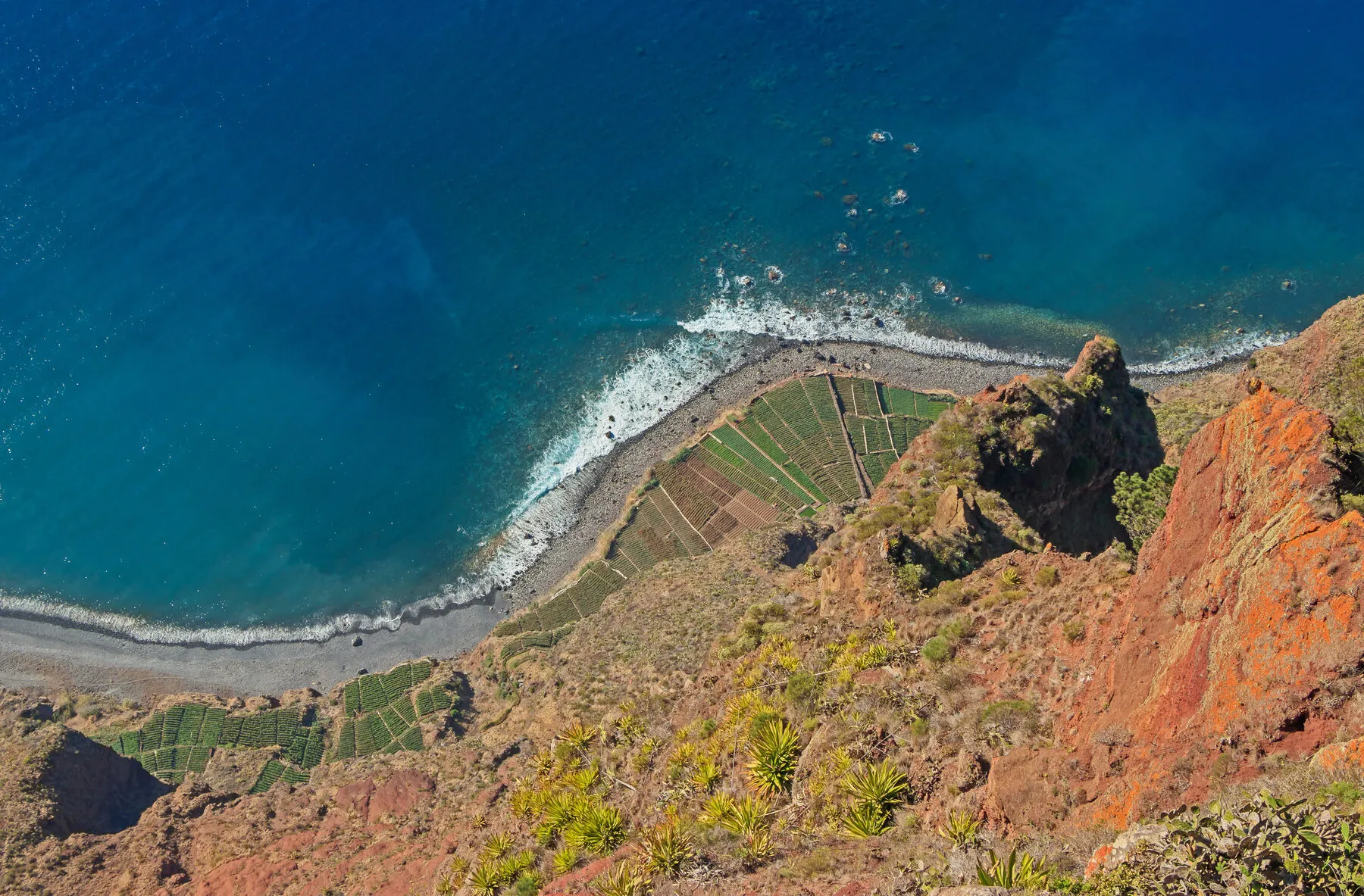
The west and the south coast hold the viewpoints and the postcard villages. Cabo Girao, near Camara de Lobos, has a glass-floor skywalk on the top of one of the highest sea cliffs in Europe, about 580 metres, with the terraced fields and the sea far below. Camara de Lobos itself is a fishing village of coloured boats, and the south coast road back to Funchal runs through the banana terraces and the small towns that make the island’s gentler side. Give the east and the west a day each if you can.
Food
Madeira eats simply and well, and the island has its own dishes rather than the mainland’s. Espetada is the signature: cubes of beef marinated in garlic and salt, skewered on a bay laurel stick and grilled over the fire, served with bolo do caco, the round flatbread rubbed with garlic butter. The Atlantic supplies limpets grilled with garlic and the black scabbard fish, served fried with banana, and the markets sell the island’s fruit, from passion fruit to the small, sweet bananas grown on the south coast terraces.
The drinks are as local. Poncha is the island’s punch, made from sugar cane rum, honey, lemon and sugar, and it is stronger than it tastes. Madeira wine, the fortified wine that gave the island its name around the world, is drunk as an aperitif or a digestif, and the lodges in Funchal run tastings. The food is good value, with a fish or skewer dinner for 15 to 30 EUR a head, and the old town of Funchal is the best place to try it all in one evening.
Where to stay
Funchal is the base for most visitors and the right one for a first trip: the old town, the market, the cable car, the wine lodges and the best restaurants are all here, and it is central enough to reach either end of the island in an hour or so. The hotel strip along the south coast just outside the city, around Lido and the lido promenade, has the big resort hotels and sea views, and the old town has smaller guesthouses and boutique stays.
For a quieter base, the south coast towns to the west, such as Calheta with its sandy beach, and the small villages on the north coast, suit anyone who wants space and a slower pace, at the cost of a longer drive to Funchal and the main trailheads. A common and sensible pattern is a few nights in or near Funchal and a night or two on the north or west coast, so you are close to both the city and the wilder half of the island.
When to go
Madeira is a mild, year-round island, which is its great advantage over the mainland. Spring and early autumn are the best all-round months, with warm days, the laurel forest at its greenest and the whales and dolphins moving along the coast. Summer is warm and busy, and the peak months fill the hotels and the popular trails, so book the levada permits and any tours ahead.
Winter is cooler and wetter but still far gentler than northern Europe, which makes Madeira a genuine winter sun option when the mainland is cold; the rain falls mostly on the north and the high interior, while the south coast around Funchal stays drier. The one constant is that the mountain weather changes fast, so check the forecast and the trail status, especially for the Arieiro to Ruivo ridge, which closes in high wind. Whatever the month, pack a light waterproof and layers for the peaks and the forest. Madeira is also one of the easier places in the country to base yourself for remote work, and the Portugal digital nomad guide covers the visa, tax and costs of a longer stay.
Practical information
| Getting around | A rented car is the practical way to see the island; buses connect Funchal with the main towns but are slow for the trailheads and viewpoints. Roads are good but steep, with long tunnels, and distances take longer than they look. |
|---|---|
| Walks | The Pico do Arieiro to Pico Ruivo ridge (PR1, about 9 km, 10.50 EUR) and the levadas, including 25 Fontes and Caldeirao Verde (4.50 EUR), plus the coastal Ponta de Sao Lourenco trail. All classified trails need a timed online permit; book in advance. |
| When to go | Mild year round. Spring and early autumn are best; summer is warm and busy; winter is gentle and good for the south coast, with rain on the north and the peaks. |
| Money and language | Euro, cards widely accepted. Portuguese, with English spoken in the tourist areas. Poncha and Madeira wine are the local drinks to try. |
| Health and safety | The sea is the Atlantic and the swimming is cold and exposed outside the sheltered pools and bays. The mountain trails have real drop-offs and changeable weather, so go prepared, check the trail status, and do not walk the ridge in high wind. |
Disclosure. This blog post contains affiliate links. If you book through them, Mediterranean Vibes may earn a small commission at no extra cost to you; it is how the site stays up.