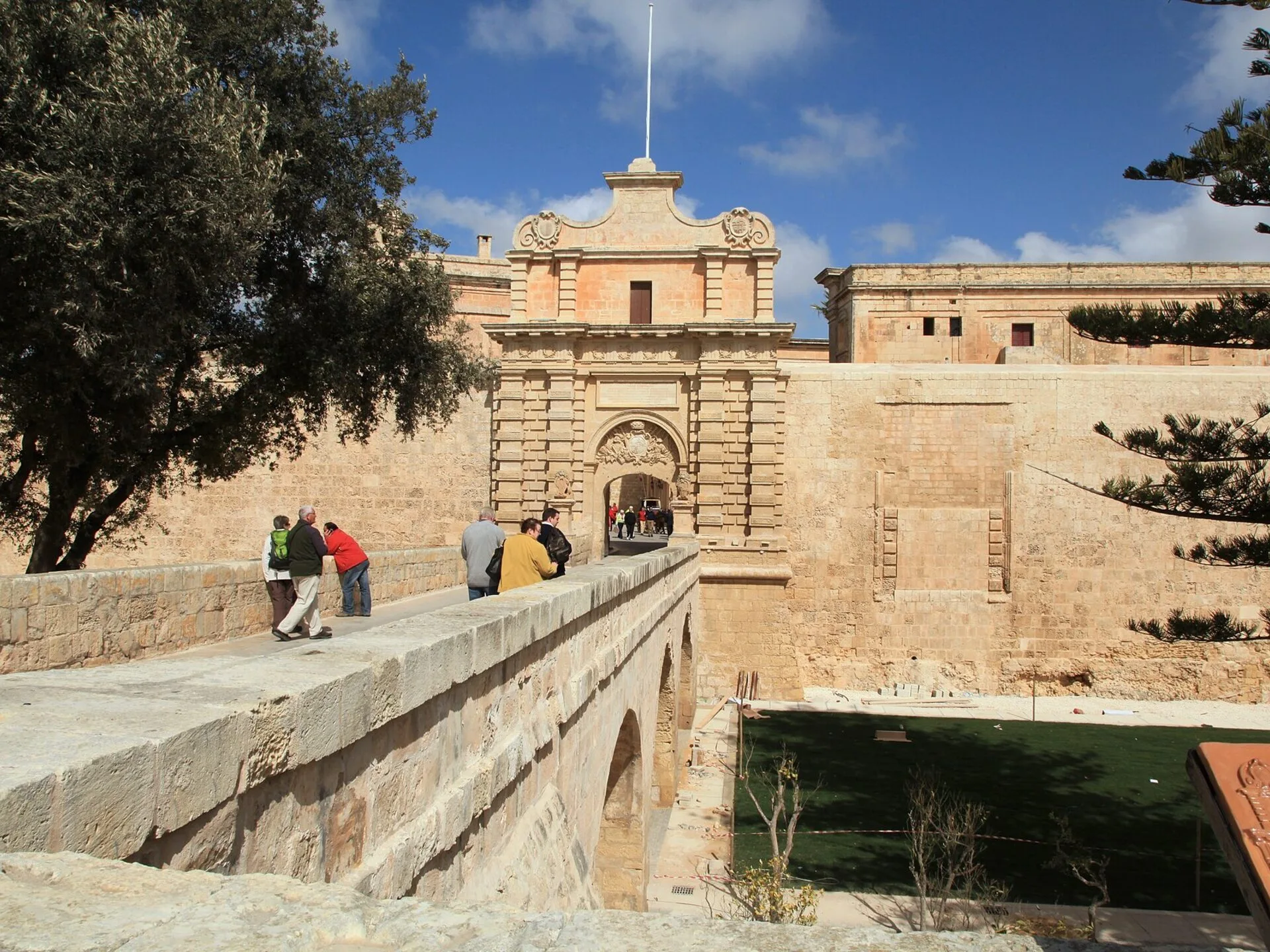
Mdina is the old capital of Malta, a walled medieval city on a hill in the middle of the island, and the quietest famous place you will visit there. It has a few hundred residents, cars are restricted inside the walls, and the whole city is small enough to cross in a few minutes on foot. That combination is why it is known as the Silent City, a name used by Malta’s own transport authority and by the UNESCO entry that has listed Mdina on its tentative list since 1998.
It is worth being precise about the heritage status, because it is often overstated. Mdina is not itself an inscribed UNESCO World Heritage Site. It sits on Malta’s tentative list, and the country has said it intends to nominate it. That does not make the visit any less good. The city was the administrative centre of the islands for close to two thousand years, until the Knights of St John moved the capital to the harbour in the sixteenth century, and the streets still carry that weight.
This guide covers Mdina itself, not the town of Rabat that runs right up to the walls, which is only the bus stop and the cheaper place to eat. It gives the 2026 ticket prices and hours with the source attached, the bus routes from Valletta and the airport, and the timing that lets you see the interiors and still catch the empty, floodlit streets after the crowds leave. Every figure is checked against an official heritage or transport page, and the one thing almost every other guide gets wrong, Mdina’s UNESCO status, is corrected above.
Plan and book
3 partners- Flights
Compare fares into Malta International Airport, about half an hour from Mdina.
Search flights - Ferries
Link the Malta trip with the Virtu Ferries crossing between Valletta and Sicily.
Compare routes - Where to stay
Rooms in Mdina and the surrounding towns, sorted by area, price, and review score.
Find a room
The city
You enter Mdina the way it has been entered for centuries, across a stone bridge and through the Baroque Main Gate that Grand Master Antoine de Vilhena put up in the 1720s. On the other side the city opens into a tight grid of limestone lanes: Villegaignon Street runs down the spine toward the far bastion, St Paul’s Square holds the cathedral, and the side streets dead-end at the walls with a sudden drop and a view across the island. There is no traffic to dodge, because access by car is restricted to permit holders through the local council.
The city is free to walk, and that is most of the experience. The two things you pay for are the cathedral complex and the smaller museums, and the rest is the streets themselves plus the bastions. Bastion Square, at the northern edge, is the best of the free views, looking out over the countryside toward the coast, and the walls and gates can be walked at any hour. If you only have an hour, this is where to spend it.
St Paul’s Cathedral
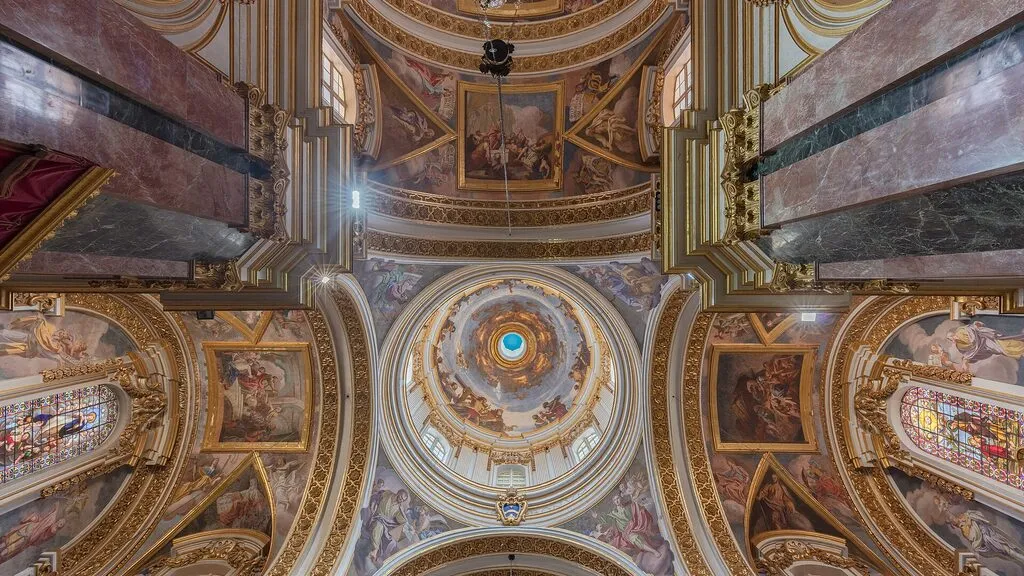
The cathedral is the centre of Mdina and the reason the city earns its place in the history books. The original medieval church was destroyed in the earthquake of 1693 that flattened much of eastern Malta, and the present building is a Baroque rebuild by the Maltese architect Lorenzo Gafa, consecrated in 1703 with its dome finished two years later. The facade faces a quiet square, and inside it is a cooler, calmer space than the honey-coloured stone outside suggests.
The combined ticket covers both the cathedral and the museum next door, and the museum is the surprise. It holds a collection of original Albrecht Durer engravings, described by the chapter as among the largest outside Germany, along with the Apostolato, an eighteenth-century silver set of the apostles that survived the French occupation, and the oldest altarpiece in Malta. The combined ticket is 15 EUR for adults and 10 EUR for seniors and students, with children under 12 free, according to the Mdina Metropolitan Chapter.
The cathedral and museum open Monday to Saturday from 09:30 to 16:30, with the last ticket at 16:15. The museum is normally closed on Sundays and public holidays, though the cathedral can sometimes be viewed from behind the rope in the late afternoon, so check on the day. This is the site that sets the rhythm of a Mdina visit: see it before mid afternoon, then spend the evening in the streets it sits among.
The natural history museum
Just inside the Main Gate, on the right, Palazzo Vilhena holds the National Museum of Natural History. The building itself is part of the draw: an eighteenth-century palace built for Grand Master Vilhena and designed by Charles Francois de Mondion, it became a museum in 1973 and now holds tens of thousands of mineral, bird, and mammal specimens, with a focus on the wildlife of the Maltese islands. It is a good-value indoor stop, and the cool rooms make it a sensible midday break in summer.
Admission is 5 EUR for adults, 3.50 EUR for youths, seniors, students, and concessions, and 2.50 EUR for children aged 6 to 11, with infants free, per Heritage Malta. From March to December it opens Tuesday to Sunday from 09:00 to 17:00, and in January and February it opens on Tuesday and from Thursday to Sunday at the same times. It closes on Mondays, and on a handful of days around Christmas and on Good Friday. Last admission is half an hour before closing.
Dungeons and bastions
Mdina’s darker attraction is the Mdina Dungeons, tucked beneath the palace just inside the gate. It is a walk-through of cells and passages with tableaux from the island’s more brutal chapters, from Roman times through the Knights to Napoleon, and it is a private attraction rather than a heritage site. Tickets are 6 EUR for adults, 3 EUR for students, and 15 EUR for a family of two adults and two children, per the official site, with longer hours in summer, when it stays open until 21:30.
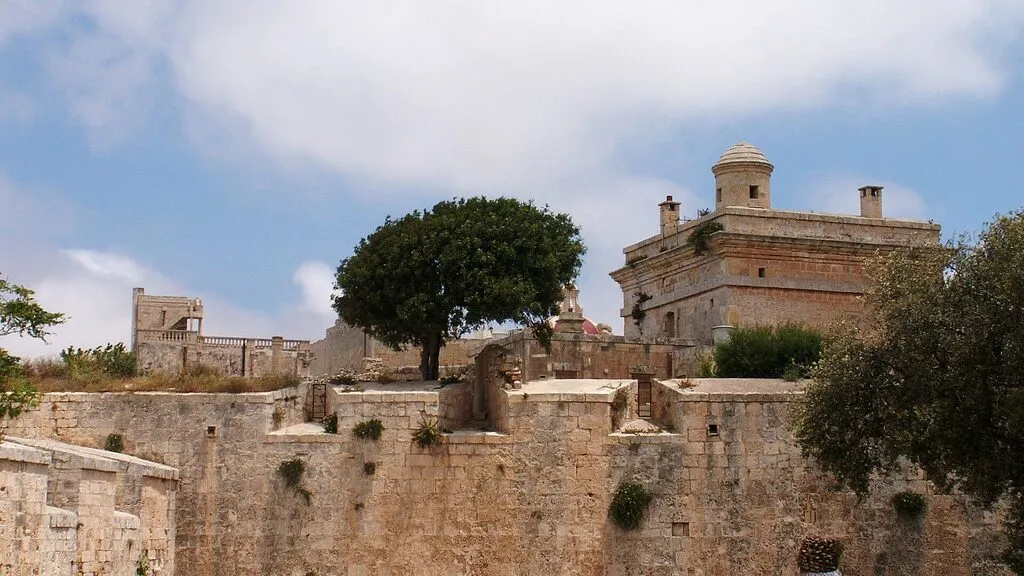
The bastions are the better use of the same half hour. The city walls are among the best preserved in the Mediterranean, rebuilt and strengthened over centuries, and the walk along the edge gives you the long views that made Mdina a fortress in the first place. Look for the Torre dello Standardo by the Main Gate, the square watchtower that once signalled between Mdina and the coast, and the older Greek’s Gate on the far side of the city, the medieval entrance that predates the Baroque one you arrive through. None of this costs anything, and at sunset it is the quietest part of Malta.
The streets
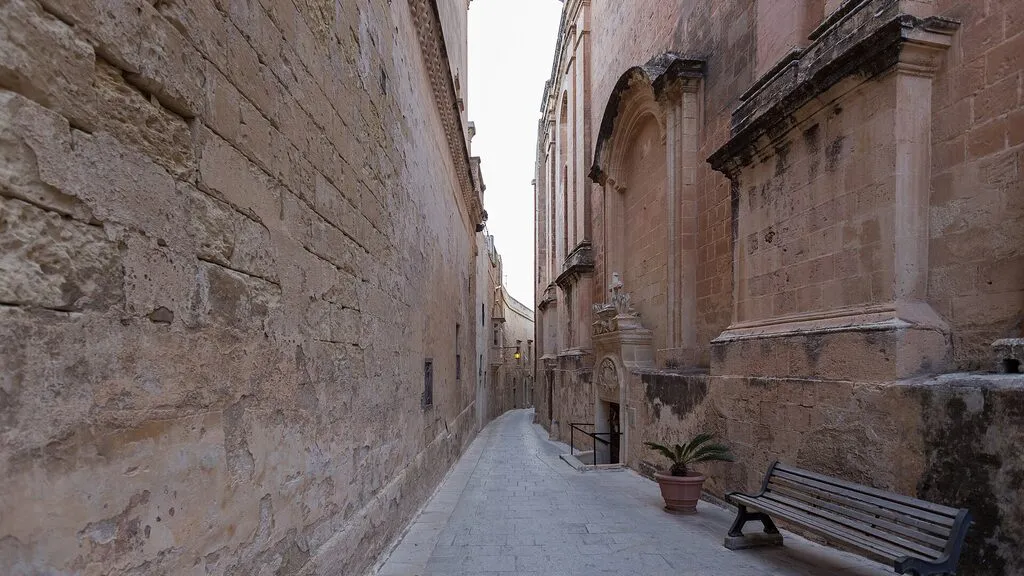
The pleasure of Mdina is the walking, and the city rewards a slow loop rather than a checklist. The lanes are narrow and shadowed, the houses are stone with painted wooden balconies and dark shutters, and every so often a gap opens onto a view or a small square with a church on it. Villegaignon Street is the main run, but the smaller streets off it, especially toward the walls, are where the city feels most itself. In the evening, when the day visitors have gone and the lamps come on, Mdina is as atmospheric as any town in the Mediterranean.
The gate has a second life as a filming location: Mdina Gate stood in for one of the gates of King’s Landing in the first season of Game of Thrones, and the city has been used in other productions since. It is a small detail in a place with far older stories, but it is why some visitors arrive, and the gate and the streets behind it hold up whether or not you watched the show.
Food and drink
Mdina is a small city, so eating is a short list rather than a scene. The best known stop is Fontanella Tea Garden on Bastion Street, which has a terrace over the walls and is famous for its cakes, priced around 5 EUR a slice on its own menu. It fills up in the afternoon, and the view from the terrace is half the reason to go. Beyond that, Mdina holds a handful of restaurants and cafes, and one well-known upscale restaurant inside the walls at the Xara Palace.
The honest move for a cheaper meal is to walk out of the Main Gate into Rabat, where the choice is wider and the prices lower. Rabat is a five-minute walk from Mdina and has pastizzerias, cafes, and restaurants that serve both towns, and the parish square is a good lunch stop between the two. Budget a few euros for coffee and pastizzi, 15 to 30 EUR for a sit-down meal, and more at the Mdina restaurants with a view. None of the Mdina dining prices except Fontanella’s own cake menu are published by the businesses themselves, so treat the ranges as indicative.
Getting there
Mdina has no bus stop inside the walls, so you arrive at Rabat and walk in. The Malta Public Transport routes from the Valletta terminus are 50, 51, 52, 53, and 56, all of which go to the Rabat interchange in roughly 30 to 45 minutes depending on traffic. From the interchange it is about a five-minute walk, some 200 metres, to the Main Gate. The single fare is 2 EUR in winter and 2.50 EUR in summer, valid for two hours with transfers, according to the operator’s fares page.
From the airport, the TD1 service runs every hour and stops at Rabat, and the regular route 201 also links the airport with Rabat, with the TD5 stopping there on its way from Bugibba. Tallinja Direct fares are 3 EUR, and 3.50 EUR for the TD1. If you are coming from Sliema or St Julian’s rather than Valletta, expect at least one change and closer to an hour each way. Driving works too, with free parking outside the Main Gate and in the Mdina ditch, but not inside the walls.
Where to stay
Mdina itself has very little accommodation, and the one place most people know is the Xara Palace, a luxury hotel inside the walls. Staying in the silent city overnight is a genuine experience, because you get the streets to yourself once the last bus leaves, but it is not the budget option. The rest of the island is close enough that most visitors base elsewhere and come for the day or the evening.
The practical alternatives are Valletta, about 30 to 45 minutes by bus, or the towns just outside Mdina. Rabat has guesthouses and is a few minutes on foot from the gate, which lets you walk in for the empty early morning without a bus. If you are based in Sliema or St Julian’s for the coast, Mdina makes an easy half-day trip, best timed so you arrive in the late afternoon and stay for dusk.
What a day costs
Mdina is cheap if you let it be, because the streets and the bastions are free. A half day with the cathedral and its museum at 15 EUR, plus a bus return from Valletta at 4 to 5 EUR, comes in around 20 EUR per person before food. Add the natural history museum at 5 EUR and the Mdina Dungeons at 6 EUR and the paid side of the city is still under 30 EUR, which is low for a place of this quality.
Food is the variable. Coffee and a pastizz or a slice of Fontanella cake is a few euros, a lunch in Rabat is 15 to 30 EUR, and a full dinner inside Mdina can run higher, especially at the top end. A comfortable half day with one or two paid sites, a cake stop, and a proper meal lands around 40 to 60 EUR per person, and a lean visit with just the cathedral and a pastizz costs closer to 25 EUR. These are planning estimates built from the prices cited above, not an official index.
Practical information
| Getting there | Buses 50, 51, 52, 53, and 56 run from the Valletta terminus to the Rabat interchange in about 30 to 45 minutes, then a five-minute walk to the Main Gate. From the airport, the hourly TD1 and route 201 serve Rabat. Single bus fare is 2 EUR in winter and 2.50 EUR in summer. |
|---|---|
| Free and paid | Walking Mdina is free, and the gates, streets, and Bastion Square are open at any hour. Paid interiors are St Paul’s Cathedral and its museum, the National Museum of Natural History, and the Mdina Dungeons. |
| Opening times | St Paul’s Cathedral and museum: Monday to Saturday 09:30 to 16:30, last ticket 16:15, museum normally closed Sundays and public holidays. Natural History Museum: Tuesday to Sunday 09:00 to 17:00, closed Mondays. Mdina Dungeons: 09:30 to 16:30 in winter, until 21:30 in summer. |
| Prices | St Paul’s Cathedral and museum 15 EUR adult, 10 EUR senior and student, under 12 free. Natural History Museum 5 EUR adult. Mdina Dungeons 6 EUR adult, 15 EUR family. Children and students pay less at each. |
| When to go | Early morning before about 09:30 or the evening after 17:00, when the coach groups have left and the streets are quiet. The paid interiors close mid afternoon, so see those first and keep the streets for the evening. |
| Heritage note | Mdina is on Malta’s UNESCO tentative list, not an inscribed World Heritage Site, and the country has said it intends to nominate it. It was the administrative centre of the islands for close to two thousand years before the capital moved to the harbour. |
Disclosure. This blog post contains affiliate links. If you book through them, Mediterranean Vibes may earn a small commission at no extra cost to you; it is how the site stays up.


.jpg)